More about the project
Tree Care Hyde Park is a series of community gatherings, plant-dyed and printed textile tree tags, and a mobile printing/planting press in the form of a wheelbarrow. Tree Care partners with local community organizations who are working to plant, preserve, and conserve trees in Hyde Park. Together we will tag 1000 trees throughout Hyde Park; as residents walk their dogs, commute to work, relax in their local parks, they will encounter the brightly colored, plant-dyed textiles tags that are printed with short texts in the form of multi-sensory invitations to get to know and commune with our tree neighbors. The tags include a link to a website with information about how each tree cares for us, how we can care for the trees, and how our community organizations are preserving and protecting trees, as well as a custom map to locate each of the sites of the project.
The project centers around community workshops led by Jane Marsching which invite us to dream together with the trees: what do they hope for us and what do we hope for them? Community members will be guided through writing prompts using ink made from the trees of Hyde Park, which they can then print using the mobile printing/planting press to make their own tree tags. Participants are invited to take a tag and hang it on a tree in their yard, street, or park.
The Tree Care Planting/Printing Press will be installed in the foyer of the historic Everett Square Theater in Logan Square, Hyde Park, when it is not in use during events. A large map of all the sites will be installed with the Tree Care Planting/Printing Press.
In aggregate 1000 tree tags spread out over the 9.1 acres of Hyde Park is a fraction of the total trees in the neighborhood, but creates a dispersed, intimate, and engaging public art experience for the community. As temporary public art works, they will be removed at the conclusion of the project.
The project’s aim is to introduce the community to the urban trees of our neighborhood as care givers and friends. We are invited to hum, breathe, move, whisper, and dream with the trees through workshops that bring us together to write invitations to the trees to join us in our everyday lives, to dream about what trees are and hope for, and to call to a culture of care for our tree kin.
Tree Care Hyde Park aligns with the aim of the City of Boston Urban Forest Plan to share the power of urban trees to improve air quality, provide wildlife habitat, reduce heat and mitigate the adverse health impacts of heat, reduce stormwater flooding, lower energy bills, capture carbon, and create an urban community that is joyful, peaceful, and beautiful.
About the artist
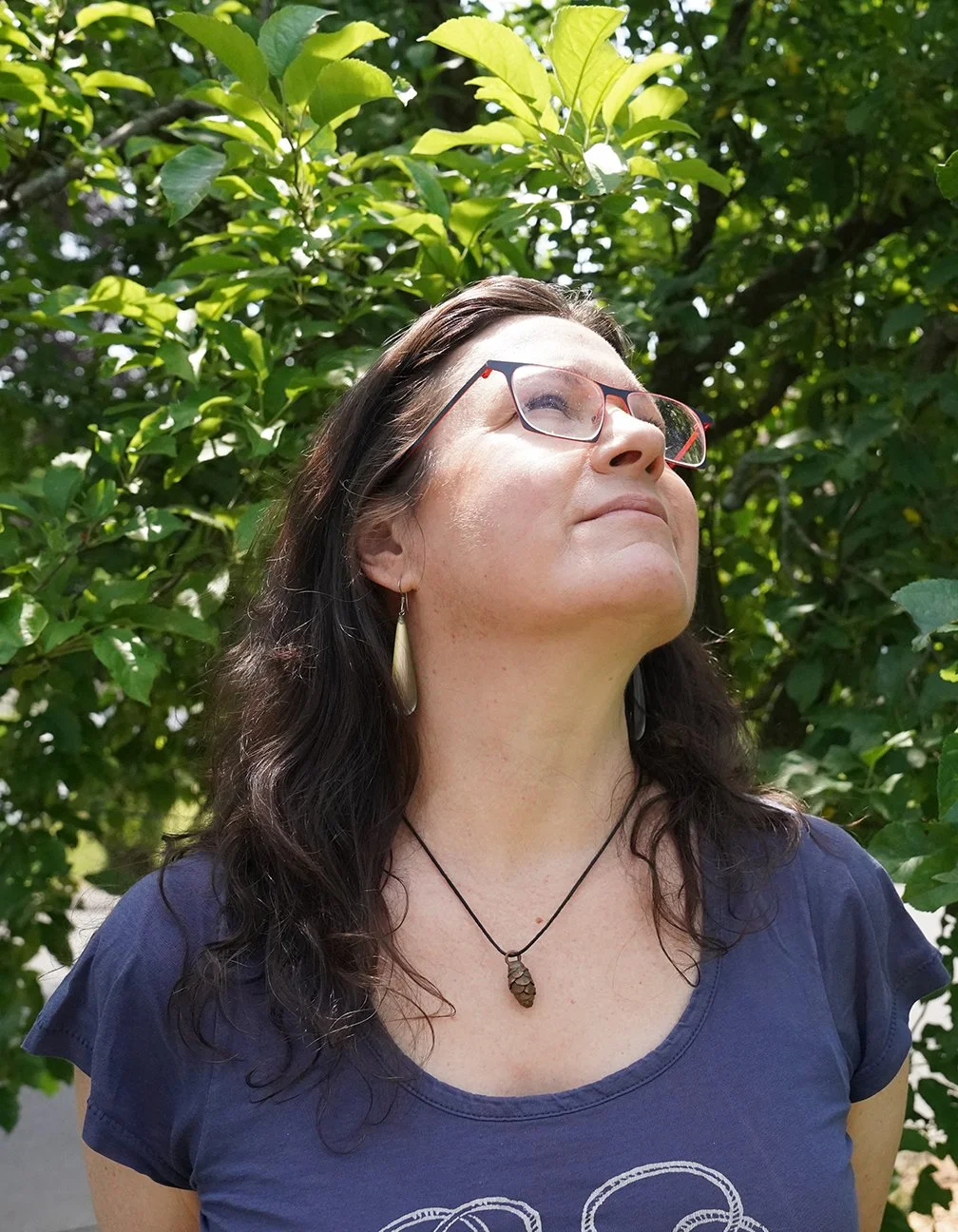
Hyde Park-based artist Jane D. Marsching’s work creates collective rituals of sensing and making that bring people into deeper relationships with the urban trees we live alongside. She believes that art can be a tool for ecological justice, climate resilience, and public imagination. Her projects over the past decade foster relationships across species and communities in a time of ecological unraveling through artistic practice, ecological inquiry, and multisensory ritual.
She has been working on a long-term project about our relationship with urban trees since 2022 entitled The Urban Tree Oracle. One of the primary ways she gets to know the trees is to make ink from the bark, nuts, berries, and flowers. People draw and write with the tree ink in participatory gatherings, a way to connect with the voice of the tree. She invites us to slow down and enter into relationship with urban trees as beings with agency, story, and insight. Through these encounters, we imagine more just, resilient, and interdependent futures.
Recent projects include Utopia Press, a mobile letterpress in the form of a backpack which was used to create large-scale banners with utopian dreams printed with tree inks in the forest, created as an artist in residence at Fruitlands Museum in Harvard, MA. Dear Harbor Radio, created as part of the collective Plotform with Andi Sutton, was a nomadic bike-powered interspecies love letter writing and recording studio that roamed the shores of Buzzards Bay, MA.
Exhibitions include: Northern Spark, Minneapolis, MN; Kilroy Metal Ceiling, Brooklyn; Galerie Lucy Mackintosh, Lausanne, Switzerland; Tierra des Explorades, Buenos Aires; ICA Boston; and MassMoCA. She has received grants from Creative Capital and Artadia, among others. An occasional writer, her most recent essay was published by St. Lucy Press in Running Falling Flying Floating Crawling, edited by Mark Alice Durant, 2020.
At Massachusetts College of Art and Design she is Professor and Director of the Sustainability Minor. She founded the MassArt Resilient Pigment Library in 2021.
Land Acknowledgement
Hyde Park’s land, waters and trees are the unceded lands of the Massachusett Tribe traditional territory. The Massachusett took their name from the Algonquian term describing the area visible from the Great Hill, now referred to as the Blue Hills, which looks out over the 9.1 acres of Hyde Park. Hyde Park’s southern border along the Neponset River watershed is part of the traditional territory of the Neponset band of the Massachusett. The river and surrounding marshes provided vital sustenance and transportation for centuries. I join the Massachusett Tribe at Ponkapoag in this gratitude they include on their website: “There are ways of perceiving and doing things in our community that trace back thousands of years. There are Medicine Ways thousands of years old that we still practice today. We thank our ancestors for keeping the traditions, for their foresight and the gifts they left to us.”
Thanks
This project is indebted to an incredible community of people, organizations, and beings who have contributed in countless ways. Firstly thanks to the Boston Public Art Triennial for the extensive support and funding that made all this possible. Shout out to the curatorial vision of Jasper Sanchez and Amor Diaz-Campos, the project management support from Leo Crowley and Morgan Collins, the communications and engagement guidance from Marguerite Wynter, Nataleigh Noble, Keegan Andrulis and Emerson Holloway, and as always the leadership and vision of Kate Gilbert. The community of the Accelerator cohort was so valuable—thank you Cara Michell, Crystal Bi, and Garrett Gould.
Heartfelt thanks to my score collaborators: Vaughn Bell, Christa Donner, Sheila Gallagher, Sandrine Schaefer, Andi Sutton and Deb Todd Wheeler. For insight, hands, and heart: Emily Gray (too many things to count), Aly Vettese (design and print magic), Jem Stephenson (amazing fabricator), Tricia Ryan (sewist extraordinaire), and Jo Lobdell (brilliant natural dyer and artist).
Hyde Park’s rich network of community and civic organizations have been so generous in their support of this project, in particular Pat Alvarez at the Southwest Boston CDC, Suzanne Hinton at the Neponset River Watershed Association, Cathy Horn at Keep Hyde Park Beautiful, Mary Margaret Pitts at the Hyde Park Library, and Pat Tierney at Insight Realty.